For this week’s Pioneering Conversation, you’ll read the key takeaways from an insightful panel on building a ‘multi-moneyverse’ at the Innovate Finance Global Summit, the flagship event of UK FinTech Week.
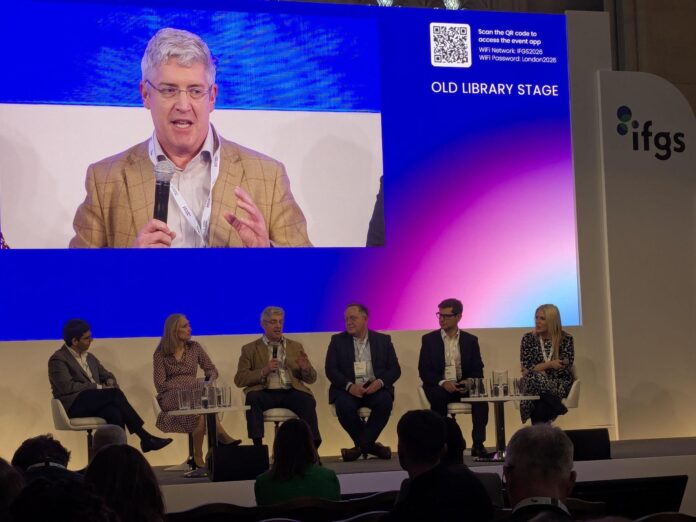
The panel featured insights from Victoria Cleland, chief cashier and executive director for payments at the Bank of England, Myles Stephenson, CEO and founder of Modulr, Gilbert Verdian, CEO at Quant, John Howells, CEO at LINK, and Kate Lowe, deputy chief business officer at Euroclear. It was moderated by Kunal Jhanji, managing director and partner at Boston Consulting Group.
KJ: Where are the opportunities as different forms of money evolve?
VC: The main focus needs to be in retail payments. We’ve recently reviewed our systems, and stablecoins and other new tech are great innovations in wholesale markets, but what the government launched a couple of years ago is the National Payments Vision, setting out its ambitions for the UK’s payments sector to deliver world-leading payments and support the growth mission.
Our main focus is on the products that give choice to consumers and businesses. In the world of payments, it’s all about enabling them to do what they want to do. When we talk about a multi-moneyverse, it’s not just about using the traditional commercial bank money, it’s a world in which you can use commercial bank money, stablecoins, tokens of money, potentially central bank money, traditional currency and use them in a seamless way.
KJ: How do you see this new world with various forms of money incorporating cash?
JH: We’re already in the multi-moneyverse: here in the UK we have cash and cards and digital money. But that’s not to say that the job is done. There are a number of key challenges. The first is inclusion because you can’t have a successful economy unless all people are able to use the various forms of money available. At the moment, about 5 million consumers in the UK very strictly like using cash.
The second challenge is interoperability, because the infrastructure has to allow all the forms of money to work together. At the moment, in the UK, you need a physical card to withdraw cash from an ATM, so if you’re using a crypto wallet there’s no way to make a withdrawal. That’s an example of a practical fix we need to improve interoperability.
Finally, sovereignty is crucial. That’s about having a strong, effective and coordinated approach in the UK to take the best from our home-grown companies, and the best from the overseas ones, including the North American firms. If we can do that, we’ll have a much less fragmented approach to the management of payments in the UK.
KJ: What will the multi-moneyverse mean for the B2B sector?
MS: That sector is facing very similar issues to the consumer sector. You need to be able to have that interoperability to ensure that cash management can happen in a seamless way. For a business to be successful, it can’t just have something that looks seamless on the front end and solves just the acceptance or disbursements or one particular problem that they’ve got. You’ve got to be able to manage the cash, because ultimately, that’s what really matters to the business. The difference compared to consumers is just the level of complexity and variability that businesses have.
On the other side, there’s a massive opportunity with new platforms being built and new technologies, such as stablecoins, to solve those issues in a more automated way and take friction out of businesses.
KJ: We’re hearing a lot about interoperability. What is the infrastructure we need in the UK?
KL: This discussion always has to start with the client and finding out what they care about as far as money is concerned. Our clients’ key concerns are about trust, finality, liquidity, accessibility and acceptance, so they want to feel confident that their money is acceptable to everyone in the wholesale market.
We’ve seen a couple of incidents this month where bridges connecting to blockchains have been hacked, and those bridges have resulted in quite high losses for consumers. Since 2021, 40% of the total losses within the blockchain infrastructure have been from interoperability and bridges. This links back to my point about consumers wanting trust; they’ll only get that with regulated infrastructure – and that’s what is being built in Europe.
KJ: How do you see interoperability in the retail context?
GV: Interoperability is not something you can do on your own, it’s a problem to be solved industry-wide. You can’t build a proprietary technology to solve the interoperability problem.
For us, we focus on digital money, not electronic money, because digital money is programmable. That means end users will have programmable bank accounts, still with the sort code and account number as it is today, but you can programme money to do things for the first time. That means if you’re sending £1, it has to be £1 across the system, between banks, capital markets, different venues and the legacy systems as well.