
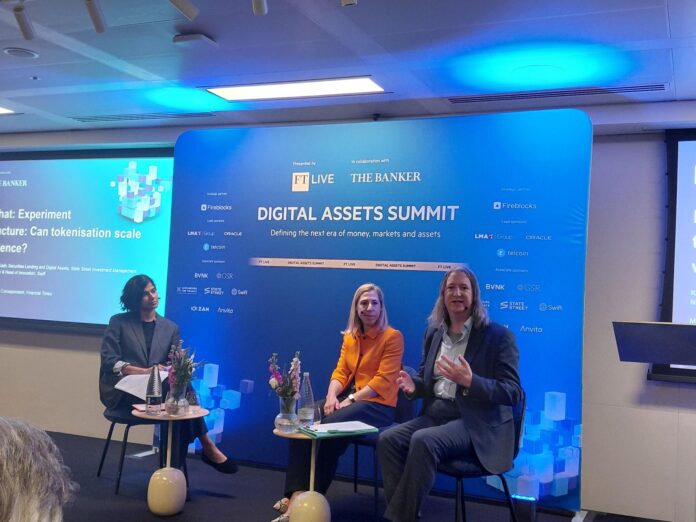
Interoperability advances are pushing institutional tokenisation into its next phase, according to leaders at Swift and State Street Investment Management.
Speaking at the Financial Times’ Digital Asset Summit in London last week, both argued that emerging standards and blockchain infrastructure are finally addressing the privacy and cross‑chain challenges that once held the market back.
Nick Kerigan, head of innovation at Swift, said institutional engagement has shifted decisively over the past two years. “Institutional adoption is starting to happen,” he said. “You’re starting to see it with key use cases achieving product‑market fit.”
He pointed to the rapid rise of tokenised US Treasury repo markets, which now exceed $300bn in daily volumes.
Kerigan said the priority now was ensuring that innovation does not “re‑fragment the market” as new chains proliferate.
“These chains need to be able to work together,” he said. “The most likely future is that there will be more than one chain, but there won’t be thousands.”
Swift is already integrating a blockchain‑based ledger into its core infrastructure — following a series of interoperability trials with SG‑Forge, HSBC and Ant Group — and Kerigan said the focus is on secure orchestration across digital money and tokenised assets.
“Crossing over these chains is a real institutional function, and therefore somebody needs to be responsible,” he said, referencing recent bridge exploits in decentralised finance. “We need to apply the learnings of operators of existing scale infrastructure.”
Kim Hochfeld, global head of digital and cash at State Street Investment Management, said tokenisation was reshaping the economics of asset management, particularly as new wrappers and collateral use cases emerge.
“It’s going to transform traditional pools of assets with new use cases,” she said. “It brings us a whole new set of distributors coming into a new investment.”
Hochfeld said interoperability is central to that shift. “If we issue a token on chain A, how does it move to an investor wallet on chain B?” she said. “How am I, as an asset issuer, confident that my token can move across the chain in a safe, secure, compliant way?”
She added that distribution remains the key determinant of which chains asset managers will support: “Why would I go on chain A versus chain B versus chain C? For me… it’s all around distribution.”
Both speakers said regulatory clarity was improving globally, enabling institutions to move faster. Hochfeld noted that State Street will only launch tokenised products where the operating model is fully understood.
“We would never launch a product where we didn’t have clarity around how it was going to operate,” she said.
Kerigan said more than 40 banks are now collaborating on Swift’s ledger initiative, while Hochfeld highlighted the momentum created by several market‑wide efforts, which would “drive institutional adoption in a significant way”, she said.
See also: State Street and Galaxy unveil on-chain sweep fund; Swift rings in Sibos 2025 with tokenisation and innovation centre stage