
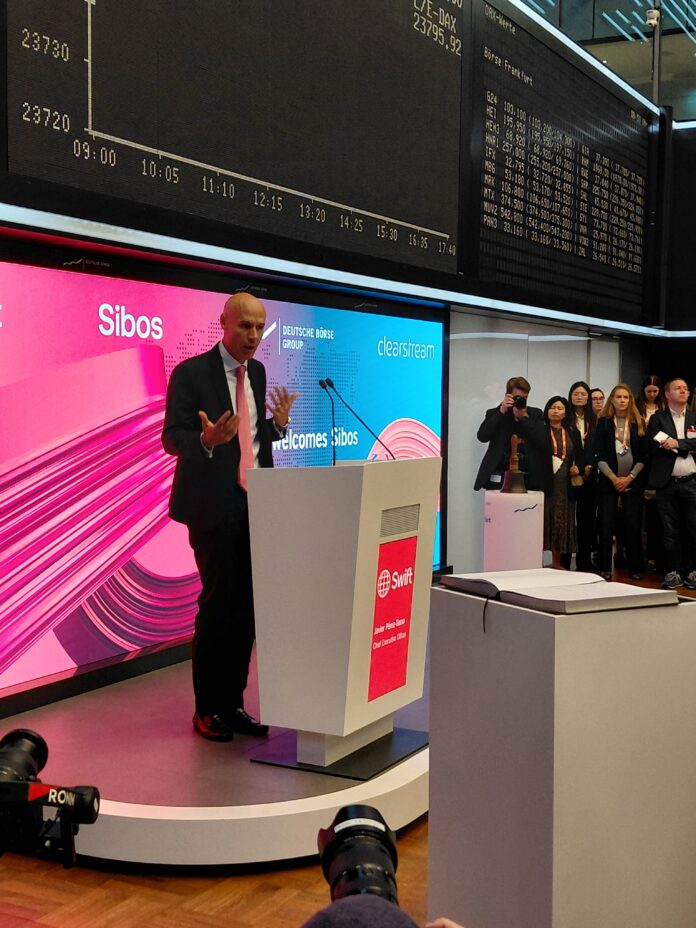
Swift has announced the integration of a blockchain-based shared ledger into its core infrastructure, marking a major milestone in its strategy to support tokenised finance and real-time cross-border payments. The move, unveiled at Sibos 2025 in Frankfurt, signals a shift from experimentation to production-grade infrastructure, with Swift positioning itself as a central enabler of digital transformation across global finance.
“This is not just about experimentation anymore,” said Swift CEO Javier Pérez-Tasso during the opening plenary of the event. “We are moving from proof-of-concept to production-grade infrastructure. The ledger we’re introducing is designed to support tokenised asset flows across multiple platforms, with the resilience and compliance the industry expects from Swift.”
Developed in collaboration with Consensys and more than 30 financial institutions, the ledger will initially focus on enabling 24/7 cross-border payments using regulated tokenised value. It will serve as a secure, real-time log of transactions between institutions, with smart contracts enforcing transaction rules. Swift’s aim is to extend its trusted role in financial messaging into the digital asset space, while maintaining interoperability with both existing and emerging systems.
“We’re not trying to build a new financial system,” Pérez-Tasso added. “We’re helping the current one evolve.”
The announcement builds on Swift’s recent trials in blockchain interoperability and reflects growing industry momentum around tokenisation. “Tokenisation is no longer a niche topic,” he said. “It’s becoming a foundational layer for securities, payments and trade finance.”
Referencing the Opening Bell ceremony held earlier in the day at Deutsche Börse’s trading hall, Pérez-Tasso noted: “These Sibos cycles are the ones that will shape the new channels in global finance. We’re proud to be doing that here in Frankfurt.”
Deutsche Börse CEO Dr Stephan Leithner echoed the sentiment: “If the next generation looks back in 10 or 15 years at the digitisation of securities and payments, they will say: we started that journey in Frankfurt.”
The ledger initiative has drawn broad support from coalition banks. In a statement to accompany the announcement, ANZ’s Nigel Dobson called it “a pivotal step toward global, instant, always-on cross-border transactions,” while Bank of America’s AJ McCray said it offers “transparency and interoperability—two priorities to effectively manage payments in a 24/7 world.”
Eva Rubio of BBVA described the project as “a game-changer,” and BNP Paribas’ Bruno Mellado noted that “the blockchain financial ecosystem will need seamless interoperability and standards between currency areas and institutions—Swift’s initiative provides the opportunity to build that foundational infrastructure.”
Swift’s strategy is to innovate on parallel tracks: upgrading existing fiat rails while creating future digital rails. The ledger will complement Swift’s work on new scheme rules for faster and more predictable payments, and its efforts to orchestrate interoperability across public and private networks.
As Pérez-Tasso concluded: “We provide powerful and effective rails today and are moving at a rapid pace with our community to create the infrastructure stack of the future.”
With over 10,000 delegates and 250 sessions, Sibos 2025 is spotlighting infrastructure transformation, AI, and digital assets. Capital Pioneer will be reporting from the conference all week.