
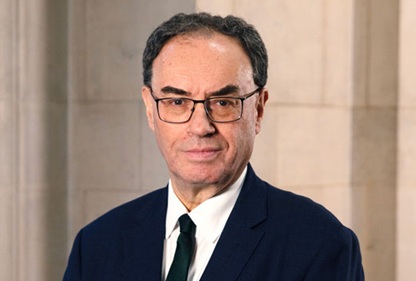
Bank of England Governor Andrew Bailey said Wednesday that any stablecoin widely used for payments in Britain must be regulated like a traditional bank, with depositor protections and access to central bank reserves, as global regulators and financial institutions sharpen their focus on digital money.
Bailey, a long‑time sceptic of cryptocurrencies, wrote in the Financial Times that it would be “wrong to be against stablecoins as a matter of principle,” but stressed that safeguards were essential if such tokens were to play a meaningful role in the financial system.
His remarks came as the Sibos 2025 conference in Frankfurt underscored how the world’s largest banks and regulators are preparing for a future where digital assets and tokenised money are embedded in mainstream finance.
At the event, Swift chair Graeme Munro and CEO Javier Pérez‑Tasso announced plans for a blockchain‑based shared ledger, signalling that the global payments network is moving to integrate tokenised value into its infrastructure.
Pérez‑Tasso said the future of payments would be defined by “more ways to move value, not fewer,” highlighting demand for instant, cross‑border settlement.
Regulators echoed Bailey’s concerns. Deutsche Bundesbank president Joachim Nagel warned that while smart contracts and distributed ledger technology could enable a “truly smart economy,” central banks would not tolerate innovations that undermine monetary policy or erode trust in money. He reiterated that the digital euro remains Europe’s most important monetary project.
Bailey’s latest remarks build on comments he made in July at the Mansion House, where he argued that stablecoins should not be viewed as a replacement for commercial bank deposits. In his new article, however, he suggested that the financial system does not necessarily need to remain structured around banks’ dominance in credit creation.
He floated the possibility of partially decoupling the functions of money and lending, with traditional banks and stablecoins operating side by side, while non‑bank institutions could take on a greater share of credit provision. Bailey cautioned that such a shift would represent a profound change to the financial architecture and must be carefully assessed before any move is made.
At SIBOS, Deutsche Bank CEO Christian Sewing urged European institutions to fund a technological and green renewal, arguing that digital assets will only gain legitimacy if embedded within a framework of resilience, sustainability, and regulatory oversight.
Together, the messages from Bailey and Sibos participants suggest a turning point: the debate is no longer whether stablecoins and tokenised assets will shape the future of money, but how they will be integrated into the regulated financial system.