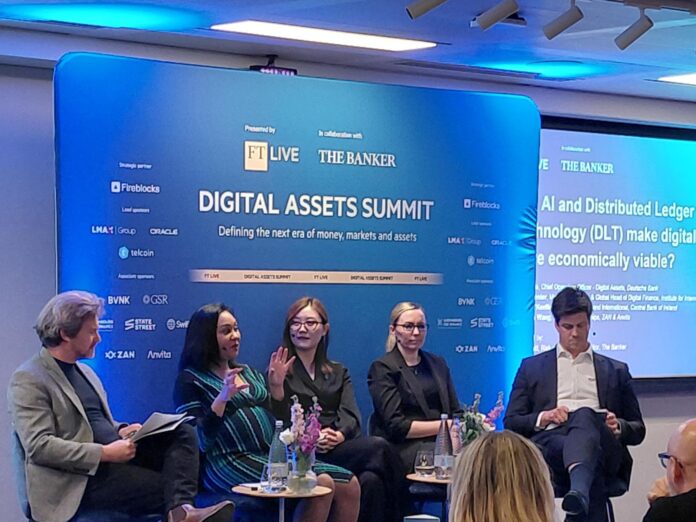
This week’s Pioneering Conversation provides insights into one of the panels at the Financial Times Digital Assets Summit, where the panellists shared their thoughts on integrating artificial intelligence (AI) and distributed ledger technology (DLT) into digital assets.
The conversation featured insights from Joy Adams, CEO of digital assets at Deutsche Bank, Jessica Renier, managing director of digital finance at the Institute of International Finance, Alexandra Wang, head of partnerships at Zan Team, Mícheál O’Keeffe, director of policy and international at the Central Bank of Ireland.
Are there any use cases of AI and DLT making digital assets commercially useful in banking markets?
JA: We already have real-world projects but they are still in the development phase, so we’re working towards them. Deutsche Bank and Clifford Chance recently published a white paper on this topic, The convergence of AI and Distributed Ledger Technology – opportunities and risks. There’s real development in play, not just sandboxing, and it’s not just on tokenised deposits, it’s also on stablecoins, and considering how to improve those with AI.
How is this new development being viewed at a large institution such as Deutsche Bank?
JA: There’s that African proverb that says “if you want to go fast, go by yourself, if you want to go far, go with other people” – and that really applies here. What we’re seeing for a lot of big banks is engagement in consortiums. For example, the DIGIT project, which is focused on natively digital Gilts, Project Agora, which Deutsche Bank plays a part in, and Project Guardian, which explores digital assets development in Asia.
I often get the question, because we also work with a lot of startups on what it would look like to work with a big company, but that takes a very long time. And I often highlight the consortium model, because that’s really where the rails are being built, as you need a very strong network effect to be able to move forward.
In terms of attitudes within companies, for digital assets and blockchain, it can feel maybe a little bit more innocuous. People don’t view it as such a large shift because it’s just the rails that are changing. But with AI, that’s where people may start to get a little bit more nervous about losing their jobs or being replaced – so you need to be careful from a culture perspective.
What challenges are policymakers facing?
MOK: The task for policymakers isn’t to predict the future. It’s to enable innovation to emerge in a safe and resilient way that allows us to deliver on our mandates as central banks and regulators. Our focus is on modernising financial systems, safeguarding monetary and financial stability, protecting investors, and maintaining financial integrity. Any well-functioning financial system needs to innovate, so these goals aren’t in conflict.
The big question is: how do we balance innovation with public trust? How do we create systems that are transparent and robust enough to fundamentally serve the public interest, but also allow innovation.
Where do you see the greatest convergence around practical use cases in the industry?
JR: Oftentimes, when we’re involved in a discussion, it’s tempting to say “let’s take one shiny topic and another shiny topic, such as AI and DLT, and if we put them together immediately, then it must be a shiny subject, right?” In this case, we’re still at a stage where these technologies need a bit more development before we can bring them together correctly.
There are great opportunities, such as agentic commerce, and obvious areas where these will bring a lot of value to the global economy, but we have to do everything in the right order before we just slam them together.
From the AI side, at a high level, the industry is making progress and there is real value in approaches that look at improving entire processes, as opposed to creating cool agents.
One application we absolutely need to focus on, and has great value, is using AI to improve compliance – particularly with respect to fraud and scams. The financial industry is losing far too much money to fraud, the full cost of which rivals the GDP of some G20 economies. That’s just not acceptable.
AW: Our end goal is to bring AI and blockchain together. We want to make sure that AI agents and digital assets are very smoothly combined. That is the vision. In practice, we did realise that it takes time and baby steps to guide our clients to do things in the right order. At the moment, tokenisation is the first step, and as institutions become more comfortable with it, the business case will only become stronger.