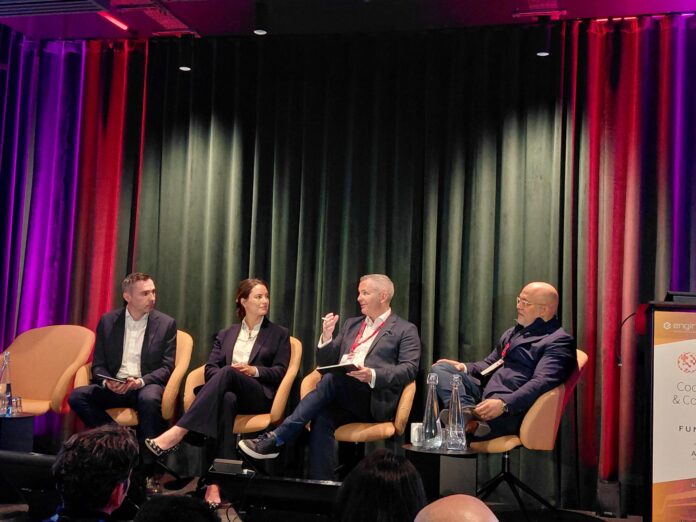
For this week’s Pioneering Conversation we’re taking you through the thoughtful discussion on the progression of tokenisation from pilots to production at yesterday’s Investment Association EmTech Global conference.
The panel featured insights from Catriona Kellas, international legal lead – digital projects at Franklin Templeton, Derrick Hastie, CTO at L&G and Ali Celiker, CEO of BPX. It was moderated by John Allan, director of innovation and operations unit at IA and director of Engine.
JA: Where are you seeing the market demand for tokenised funds?
DH: The strongest business case right now is the distribution one. It’s not just about upgrading plumbing so that we can put our funds on chain, it’s really about stepping into a whole new distribution universe, and suddenly we can now start to reach players that we couldn’t reach before.
We can reach digital distributors. We can reach blockchain-native exchanges and also on chain treasurers, where our products couldn’t quite get to them before.
As one of the largest players in the money market fund market, we see that as a real door-opening opportunity.
JA: What has changed in the last year and what barriers have you encountered?
CK: One of the biggest barriers that we’ve seen, and that has definitely shifted and improved, has been understanding of what we’re actually talking about when we talk tokenisation. There was certainly a tendency to conflate blockchain technology with crypto assets, so every time you talk tokenisation, you could see people’s eyes glaze over, and they were immediately thinking about all the risks and the volatility that you see in what I would call the pure crypto market. That was definitely evident in discussions with regulators, counterparties and potential clients.
The other side is the operational challenges. As traditional asset managers, we understand the operations, we understand how to get those things done. When you apply the 75 years of wisdom that our business collectively has to the new technology, you can start to deliver it in a way which has safety and soundness at its core.
JA: How is the digital securities sandbox (DSS) developing?
AC: The purpose of that sandbox is to turn off specific laws that prevent innovation around using blockchain applied to financial services. For example, CSDR regulations require securities to be registered on a centralised ledger; however, this is not a requirement in the sandbox. Meaning you can apply distributed ledger technology to the central securities depository process.
Also, legal settlement finality itself is less questionable inside the DSS than it is outside the DSS. There is no question about whether a transaction is final. The changes that it now enables to the current laws support legal settlement finality.
Finally, the DSS is very helpful from the perspective that you can operate as a central securities depository, more specifically, a digital securities depository, a much lower reg cap entry level, and then through time, ramp up and meet higher standards at the Bank of England for that particular function.
JA: What are your main lessons learned?
DH: It’s like any other major transformation you go through in a business: You need to take everybody with you. That includes c-suite, legal, distribution, even your IT colleagues. Bring the whole firm with you.
It’s that constant education, it’s that storytelling. It’s not actually just trying to get the limelight, and that’s difficult at the moment, particularly when AI is there. Having that ongoing narrative in the organisation is critical.
As you’re moving the whole organisation as well, it’s just the realisation that these things can often be slow but slow doesn’t necessarily mean bad.
Answers have been edited for clarity and length.